


The long road to education
Data stories – 100 Years of changes in Italy
Literacy and Schooling
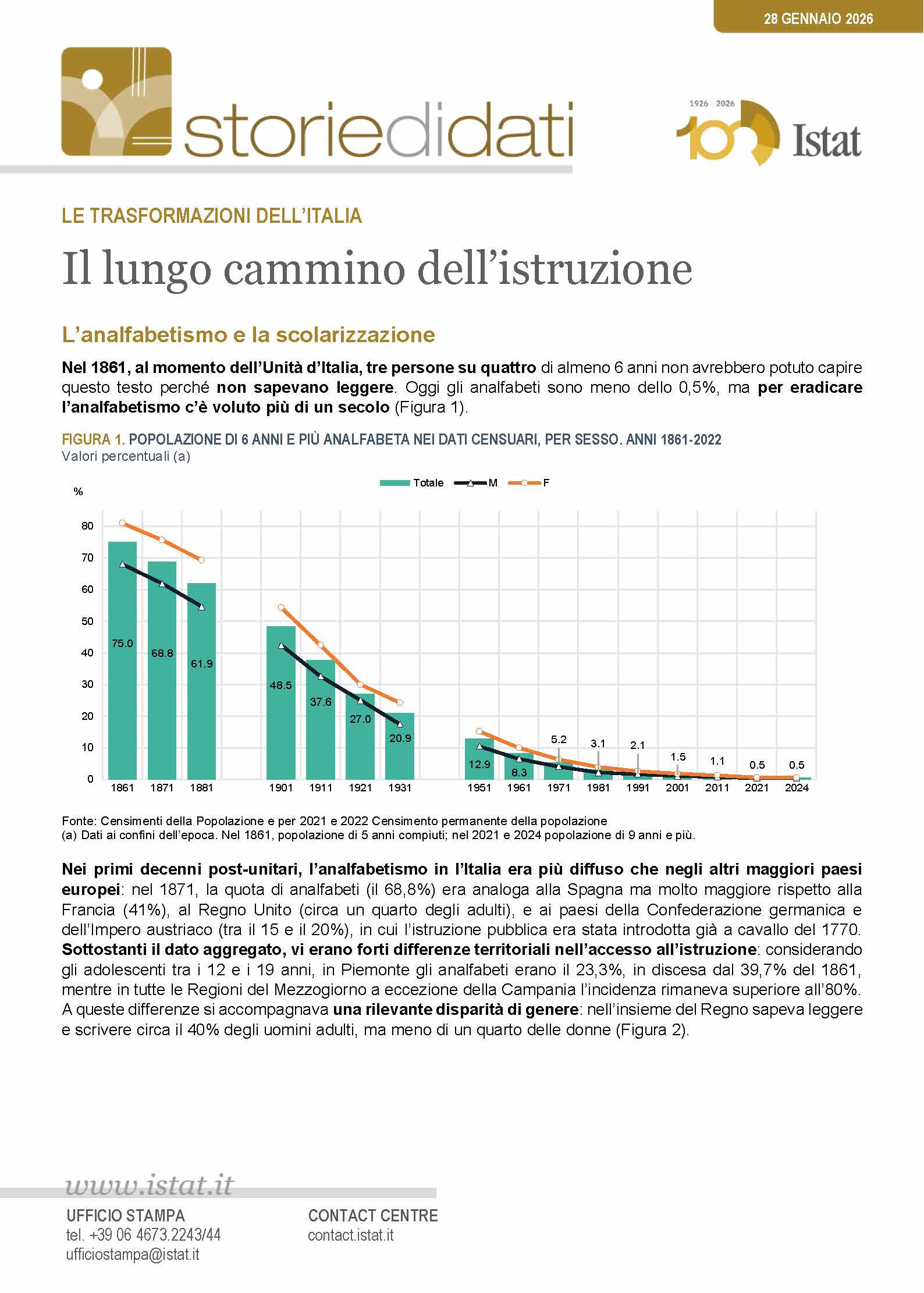
In 1861, at the time of Italy’s Unification, three out of four people aged at least 6 years would not have been able to understand this text because they could not read. Today, illiterates account for less than 0.5%, but it took more than a century to eradicate illiteracy (Figure 1).
In the first post-unification decades, illiteracy in Italy was more widespread than in other major European countries: In 1871, the proportion (68.8%) was similar to Spain but much higher than in France (41%), the United Kingdom (about a quarter of adults), and the countries of the German Confederation and the Austrian Empire (between 15% and 20%), where public education had already been introduced around 1770. Beneath the aggregated data, there were strong territorial differences in access to education: considering adolescents aged between 12 and 19, in Piemonte analphabets accounted for 23.3%, down from 39.7% in 1861, while in all Southern regions, with the exception of Campania, the incidence remained above 80%. These differences were accompanied by a significant gender disparity: across the Kingdom, about 40% of adult men could read and write, but less than a quarter of women (Figure 2).
In the following decades, progress was gradual, and uneven between North and South and between cities and rural areas, partly because until the beginning of the twentieth century, the responsibility for providing primary education rested on the Municipalities, which in many cases did not have the necessary resources. Full participation in primary education was achieved at the end of the First World War (Figure 3), but a hundred years ago – in 1926 – about a quarter of the population aged at least 6 years, and 13.5% of spouses, mostly young and therefore more educated, could not sign the marriage certificate because they were illiterate: this phenomenon only came to an end in the mid 1960s (Figure 4).
Efforts were made to provide adult literacy in several ways: from courses for conscripted soldiers (which help explain the gender gap in the pre-war period), to the establishment of evening schools and, in the post-Second World War period, with popular schools: the courses of the latter, which also provided training activities, were attended by 7.7 million people in the twenty-five years between 1947-48 and 1971-72, including almost 2.9 million illiterate adults, with an approximately equal presence of women from the mid-1950s. It is also worth remembering the first example of distance learning in radio and television format carried out in Italy by Rai, the Italian public broadcasting company: the broadcast “non è mai troppo tardi” (It is never too late), aired between 1960 and 1968.
The growth of higher education
I progressi nell’istruzione superiore sono stati più tardivi, ma anche più rapidi. Nel 1951, il 90% della popolazione di 6 anni e oltre disponeva al più della licenza elementare: il 5,9% aveva la licenza media, il 3,3% un diploma e appena l’1% un titolo universitario. Oggi, oltre metà dispone almeno di un diploma secondario superiore e il 16% di un titolo terziario (Figura 5).
Progress in higher education has been slower, but also more rapid. In 1951, 90% of the population aged 6 and over had at most an elementary school leaving certificate: 5.9% had a lower secondary school certificate, 3.3% a high school diploma, and just 1% a university degree. Today, over half have at least a high school diploma and close to 17% a tertiary qualification (Figure 5). A hundred years ago, in 1926, fewer than 8,000 people graduated each year; 50 years later, in 1976, there were 72,000, rising to 171,000 in 2001 and – following the introduction of first-level degrees – over 400,000 in 2024; the female share was 15% in 1926 and about 30% in the 1950s, but it has consistently exceeded the male share since 1991 (Figure 6).
Young people in a European comparison
In 2024, 31.6% of 25–34 year olds obtained a university certificate or a diploma (38.5% among media). Tand only 19.3% had at most a middle school certificate. However, in a European comparison, Italy remains among the countries with the highest incidence of poorly educated young people (although sharply declining compared to 2004) and, due to the limited spread of post-diploma qualifications, it is second to last for tertiary certificates or diplomas. At the regional level, the incidence of graduates exceeds 35% (and 45% among women) in several regions of Central and Northern Italy, but is below 25% in Puglia and Sicilia (Figure 7).
The orientation of tertiary studies underwent considerable changes over the last 100 years, due to the expansion in the range of courses on offer associated with the diversification of demand for professional skills and, more recently, the effects of the introduction of short-cycle degrees. The proportion of technical-scientific degrees decreased and even more so those in law, which fell from more than a fifth to 6% of the total, to the benefit of the economic-statistical, political-social, and human sciences groups. There are, however, strong gender differences, which are reflected in employment and income opportunities: graduates with a technical-scientific specialisation account for about half of the total among males and just over 30% among females (up to a 3 to 1 ratio for engineering and architecture). Women are also less represented in economic-statistical disciplines and, conversely, in 2024, in almost half of the cases, they obtained degrees in human and social sciences (excluding economics), a proportion double that of men (Figure 8).
Data and additional resources
- Chart data
- For a systematic collection of historical statistical data on Italy, please refer to seriestoriche.istat.it (being updated)
- For recent data on university students and graduates, see MUR, Portale dell’istruzione superiore
- For the evolution of legislation and statistical sources on education in Italy, see Istat, ‘Istruzione’ (History of sources in the website seriestoriche.istat.it)
- For the development of literacy in Europe in the second half of the nineteenth century, see the study by Joerg Baten (2022) for the UNESCO, Schooling, literacy and numeracy in 19th Century Europe: long-term development and hurdles to efficient schooling
- On the state of literacy by territory and gender at the time of national unity, also compared with France, see Jean-Michel Sallman (1989), “Les niveaux d’alphabétisation en Italie au XIXe siecle”
- On the processes of literacy from census data in Europe between the 19th and 20th centuries, their comparability and the relevant sources, see José Manuel Gutiérrez (2024), “Census-based comparability of data on literacy processes in Western Europe”
- For the characteristics of the population recorded in the Censuses, refer to the bibliography in I censimenti nell’Italia unita. Le fonti di stato della popolazione tra il XIX e il XXI secolo. Annali di statistica – SERIE XII – VOL.2
Note
- ↑Poor adherence to compulsory education, introduced with the extension to the Kingdom of Italy of the Casati Law of the Kingdom of Sardinia of 1859, led in 1877 to a new legislative intervention, with the Coppino Law. However, the provision of services remained entrusted to the Municipalities using their own funds. The state’s assumption of responsibility for elementary education occurred only in 1911, with the Daneo-Credaro Law, which also provided material aid (shoes, books) for the neediest families. The organization of the education system and the duration of compulsory education changed over time: from a two-year compulsory period with the Casati Law to three years with the Coppino Law; compulsory education was extended up to 12 years of age with the Orlando Law of 1904, which required Municipalities to provide the service at least up to the fourth grade, introducing forms of assistance for families and Municipalities with poorer budgets. The training required for teaching staff was often very modest, as were the salaries of teachers, particularly in the poorer Municipalities. Furthermore, resources to fund adult education, also provided for in the Coppino Law, remained very limited until after the Second World War. In cities literacy was more widespread compared to the surrounding territory, also due to the concentration of professional classes: for example, in 1871 in the municipality of Milan, illiterate adults were 17.6%, while in the province as a whole they reached 40%.
- ↑Here measured approximately as enrolled compared to the population aged between 5 and 9 years, including repeaters.
- ↑This indicator – used to estimate the minimum historical share of illiterates, given that one can sign without truly knowing how to read and write – in France in 1926 was around 1% of spouses (Insee, Statistical Yearbook 1951).
- ↑With approximately 12,000 classes, 150,000 adults organized into listening groups, and another 500,000 regular listeners.
- ↑During the same period, the population aged between 20 and 29 – a reference for university studies – rose from 6.6 million in 1926 to a peak of 9.2 million in 1992, then decreasing to approximately 6.0 million currently. Compared to the population in this age group, the progress recorded is therefore smaller until the early nineties and much greater thereafter: in the last 25 years, the flow of master’s/single-cycle graduates has grown by 50% relative to the 20-29 year olds, while remaining stable in absolute terms.
- ↑Female advantage in tertiary education is a common characteristic in EU countries. In 2024, among 25 to 34 year olds this stood at 13.5 percentage points in Italy and 11.2 points for the EU27 as a whole.
- ↑The Italian figure exceeds that of the EU27 by 5.4 percentage points in the case of low educational attainment and is 12.4 percentage points lower for university degrees. The trend for young people with low educational attainment is influenced by the reduction in school dropouts, and for 20–24 year olds today it has fallen below the EU27 average (13.5% against 14.9%). Similarly, among 25–29 year olds, Italy moves from last to fourth-to-last in the share of graduates, and excluding ISCED 5 qualifications (two-year post-secondary), the production of tertiary qualifications relative to the 20-29 population is in line with the EU average.